
Website: dishgoodbye.com
Telephone: 0333 220 2436
Email: [email protected]
Could one overlooked dish complicate an otherwise tidy commercial handover? Commercial lease end dish removal involves more than taking down the dish: brackets, redundant cables and fixing holes can all affect the finished exterior. Dish Goodbye removes satellite dishes and associated equipment from commercial properties across the UK.
Who should arrange the work depends on the lease, property records and agreed handover requirements. Review these before the final inspection and agree who will organise removal. Include the whole setup in your plan, not just the dish, so brackets, cables and fixing holes are not overlooked.
This checklist will help you identify redundant equipment, plan removal and record the condition of the exterior afterwards. Dish Goodbye removes dishes, brackets, fixings and redundant cabling, fills and smooths the resulting holes, and processes removed metal and electronic waste through approved recycling centres. A clear plan helps you account for the work as you prepare to hand back the property.
For commercial satellite dish removal across the UK, visit dishgoodbye.com, call 0333 220 2436 or email [email protected].
Key Takeaways
- Include commercial lease end dish removal in your handover preparations. Check for leftover brackets, cables and fixing holes as well as the dish.
- Review the lease, property condition records and agreed handover requirements to clarify who should arrange removal.
- During your walkthrough, note visible equipment and cable routes from a safe position. Do not climb to inspect roofs or high areas.
- Plan removal and exterior reinstatement together, then record the completed work for your handover documents.
- Dish Goodbye removes dishes and aerials from commercial properties across the UK, including associated fixings and redundant cabling.
Commercial Lease-End Dish Removal: Why Add It to Your Handover Checklist?
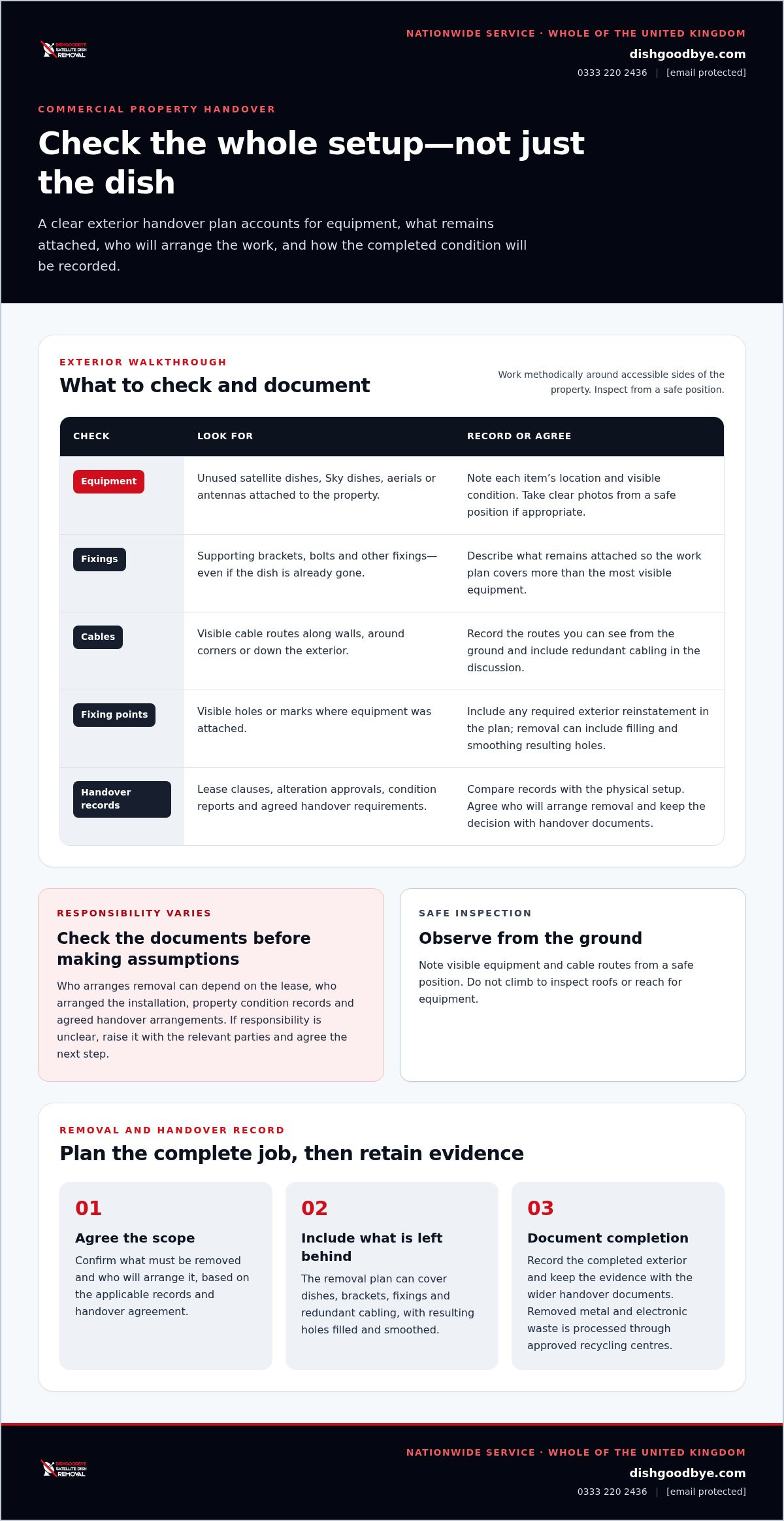
Walk around the outside of the property as carefully as you check the rooms inside. Add commercial lease end dish removal to the handover checklist alongside other visible tasks, such as recording marks, damage or items that need attention. This initial check is for identifying what is present. Whether removal is required, and who is responsible, depends on the lease, property records and agreed handover requirements.
A dish is often only the most visible part of the setup. Look for its supporting bracket, bolts or other fixings, cable routes along the walls, and holes left where equipment has been attached. A dish may already be gone while a bracket or cable remains, leaving the exterior looking unfinished. Recording these details early helps you describe the work that needs to be discussed and planned.
What counts as redundant satellite equipment?
Look for unused satellite dishes, Sky dishes, aerials and antennas attached to the property. Check visible exterior surfaces for associated brackets, fixings and cable runs, including cables that continue around a corner or down a wall. This general description of trade fixtures may help distinguish items installed for a business from the building itself, but it does not determine what your lease requires. The purpose here is to identify equipment for potential removal, not to arrange a new installation.
Why check the exterior before handing over?
Make a simple record before work begins. Note where each item is, what remains attached and which cable routes are visible from the ground. If appropriate, take clear photos from a safe position so you can compare the exterior after the work. Do not climb to inspect a roof or reach for equipment.
Redundant equipment is hardware attached to a property that is no longer needed for its use. Identifying it early helps you plan for both the dish and the details left behind. Professional removal can cover dishes, brackets, fixings and redundant cabling, with the resulting holes filled and smoothed to help maintain the exterior. Dish Goodbye provides commercial dish and aerial removal across the UK, helping leave the outside clearer and more ready for handover.
Who Handles Commercial Dish Removal at Lease End?
There is no single answer for every commercial property. Responsibility can depend on the lease wording, who arranged the installation, property condition records and handover arrangements agreed between the parties. Treat commercial lease end dish removal as two separate questions: what does the handover require, and who will arrange the physical work?
Start with the documents rather than assumptions. Look for clauses or records about fixtures, alterations, repairs, reinstatement and the condition in which the property should be returned. Then compare those details with what is actually present: the dish, brackets and fixings, cable routes, and visible fixing points. For example, a written record may refer to an approved alteration while the current exterior shows equipment or cabling that still needs to be discussed.
What should the lease-end review include?
Read the relevant lease clauses alongside any alteration approvals, condition reports and agreed handover requirements. Note where the documents and the physical setup appear to differ. General information is not a definitive interpretation of your lease or a legal conclusion about who must act. If responsibility is unclear, raise the point with the relevant parties and agree the next step before arranging removal.
Some online guidance describes tenants’ rights to install reception equipment in specific circumstances. The FCC's OTARD rule is a United States rule and does not determine responsibility under a UK commercial lease. For this handover, focus on the applicable lease documents and the agreement between the parties.
How can both parties document the decision?
Make the outcome easy to understand later. Take dated photographs from a safe position, showing the equipment’s location and visible condition. Add a brief written note identifying what is present and the agreed action. Keep the record with the wider handover documents.
- Identify the dish, brackets, fixings and visible cable routes.
- Record the agreed action and who will arrange it.
- Set out the intended completion point, then retain evidence of the finished exterior.
Clear notes can prevent an unresolved conversation becoming a last-minute handover snag. Once the parties agree that equipment should be removed, arrange the practical work as a separate step. Dish Goodbye provides commercial satellite dish removal across the UK, including associated brackets, fixings and redundant cabling. See the commercial dish removal service to arrange the work.
Commercial Property Exterior Checklist: Dishes, Brackets, Cables and Holes
Use a ground-level walkthrough to record what is attached to the building and where. A complete inspection considers the dish, its associated fixings and cables, not just the most visible piece of equipment. This makes it easier to describe the work needed for commercial lease end dish removal and compare the exterior before and after it.
How to record redundant equipment during a walkthrough
Start with each accessible side of the property and work methodically around it. Photograph the dish, brackets, visible cable routes and surrounding surface from a safe position on the ground. Add a short location note, such as “rear elevation, above the loading entrance,” to make each image easy to match to the building. Do not climb ladders or attempt to reach roof-level equipment. Note any areas you cannot safely inspect.
- Note whether the dish, bracket or cable appears loose, damaged or disconnected.
- Record visible cable routes, including where they run down or across an exterior wall.
- Check around mounting points for fixing holes, gaps, staining, loose fixings or surface deterioration.
- Keep the existing condition record separate from the post-removal record, using dated photographs where possible.
Look at the surrounding masonry or other exterior finish without touching or disturbing the equipment. A hole or gap around a fixing can be a potential entry point for moisture, but its presence alone does not establish that moisture has entered or caused damage. Record what you can see and leave any diagnosis to an appropriate inspection.
Which signs of exterior damage should you note?
Describe visible conditions plainly. For example, note a missing fixing, cracked render, staining beneath a cable or a hole around a bracket. Avoid guessing when a mark appeared or what caused it. If removal has not yet taken place, keep the initial condition record separate from the post-work record so the handover documents show what was present beforehand.
Keep the jurisdiction clear, too. The FCC Over-the-Air Reception Devices Rule is US guidance, not a rule for UK commercial property handovers. For this walkthrough, focus on accurately recording equipment and visible exterior condition. Refer to the lease and agreed handover arrangements for decisions about responsibility.
Before Handover: Plan Safe Removal and Exterior Reinstatement
Once the task is agreed, plan it as a sequence: arrange removal, address fixing holes, then record the completed exterior. Treat commercial lease end dish removal as one joined-up handover job, not simply taking down the dish. Brackets, fixings and redundant cables matter too, as does the condition of the surface afterwards.
Keep safety in view. Roofs and ladders bring fall risks, so do not attempt work at height without appropriate competence and equipment. A ground-level walkthrough is useful for noting what needs attention, but it is not a reason to climb or reach for equipment. Include safe access in the handover plan and leave work at height to people equipped to carry it out safely.
What does a complete removal task cover?
Dish Goodbye’s removal service covers the dish, associated brackets and fixings, and redundant cabling. Fixing holes are filled and smoothed to help maintain the building exterior. Removed metal and electronic waste is processed through approved recycling centres. Including these steps in the agreed task helps avoid a half-finished result, such as a dish removed while its bracket or cable is left behind.
When arranging the work, use your walkthrough notes to identify the equipment and visible cable routes. The required work can vary with the property and what is attached, so avoid assuming a particular finish or completion time. Plan to record the exterior condition once the work is done.
How should the handover record be updated?
After removal, take clear photos of the affected areas only when no satellite dish or aerial is visible in the frame. Record what was completed and note any remaining property issues separately, such as existing surface marks that still need attention. Keep these records with the wider handover documents so the before-and-after condition is straightforward to follow.
For a more straightforward handover, arrange professional commercial dish removal with Dish Goodbye, serving commercial properties across the UK.
Final Lease-End Dish Removal Checklist: Get the Property Ready
A clear plan helps keep this handover task from becoming a last-minute snag. For commercial lease end dish removal, review the records, identify what needs to go, agree who will arrange the work and keep a note of what was completed. This accounts for the dish as well as the less obvious parts of the setup.
A concise checklist to use before handover
- Review the records. Check the relevant lease clauses, property condition records and any agreed handover requirements.
- Identify what is redundant. Note each unused dish, aerial, bracket, fixing and visible cable route. Record its location and condition from a safe position.
- Agree responsibility. Resolve who will arrange the work with the relevant parties before booking removal.
- Plan the full task. Include removal of the equipment and associated fixings, attention to fixing holes, and appropriate waste handling.
- Document the result. Update the handover record with the completed work and any remaining exterior issues. After photos should show no satellite dish or aerial.
Keep the notes specific and factual. For example, record a dish and cable on a named building elevation rather than simply writing “old equipment outside”. Clear details make it easier to follow what was agreed and compare the exterior record with the completed work.
When professional removal makes the task easier
Having the dish, brackets, fixings and redundant cabling dealt with as one task helps avoid leaving loose components behind. Dish Goodbye provides commercial dish and aerial removal across the UK. The service includes filling and smoothing fixing holes to help maintain the building exterior, and removed metal and electronic waste is processed through approved recycling centres. The resulting finish can vary with the surface and its existing condition, so record any separate exterior concerns clearly.
Ready to include removal in your handover plan? Arrange nationwide dish removal with Dish Goodbye.
Leave the Exterior Ready for Handover
Make commercial lease end dish removal easier to manage by checking the lease and property records, identifying redundant equipment, and agreeing who will arrange the work. A careful exterior review helps catch more than the dish itself, including brackets, fixings, cable runs and holes that could otherwise be missed.
Dish Goodbye removes dishes, brackets, fixings and redundant cabling from commercial properties across the UK. Fixing holes are filled and smoothed to help maintain the exterior, while removed metal and electronic waste is processed through approved recycling centres. Bringing the work together also gives you a clearer record for handover.
Ready to take the next step? Arrange nationwide dish removal with Dish Goodbye.
dishgoodbye.com
0333 220 2436
[email protected]
Frequently Asked Questions
Who is responsible for removing a satellite dish at the end of a commercial lease?
Responsibility depends on the lease, property records and any handover arrangements, so neither landlord nor tenant should assume it automatically falls to them. Review clauses about fixtures, alterations, repairs and reinstatement, then discuss any uncertainty with the relevant parties before arranging commercial lease end dish removal. Record what is agreed, who will organise the work and what needs to be removed, including brackets and redundant cables.
Should a commercial satellite dish be removed before a new tenant moves in?
That depends on the agreed handover requirements and whether the equipment is needed for the property or incoming tenant. Check the lease, condition records and arrangements between the parties, then decide whether removal should form part of preparing the exterior. If removal is agreed, include the dish, brackets, fixings and cables in the plan, and record the completed work before the handover process is finished.
Can old satellite dish fixing holes cause damp?
Fixing holes or gaps around old mounting points can be potential entry points for moisture, but their presence alone does not prove that damp has occurred. Note visible holes, staining or deterioration during an exterior inspection and arrange for the holes to be filled and smoothed as part of removal. Dish Goodbye fills and smooths fixing holes to help maintain the exterior, but any existing damp or wider building issue should be assessed separately.
Does satellite dish removal include brackets and cables?
Dish Goodbye’s removal service covers the dish, associated brackets and fixings, and redundant cabling. This addresses more than the dish itself, helping avoid leaving a wall-mounted bracket or visible cable run behind. Fixing holes are filled and smoothed to help maintain the building exterior. Identify the equipment and visible cable routes during your handover walkthrough so the full setup is clear when arranging removal.
What happens to a satellite dish after professional removal?
After removal, metal and electronic waste is processed through approved recycling centres. The work also addresses associated brackets, fixings and redundant cabling rather than leaving those parts attached to the building. Fixing holes are filled and smoothed to help maintain the exterior. For handover records, document the completed work and take after photos only when no satellite dish or aerial is visible in the frame.
Can Dish Goodbye remove satellite dishes from commercial properties across the UK?
Yes. Dish Goodbye provides satellite dish and aerial removal for commercial properties across the whole of the UK. The service covers dishes, brackets, fixings and redundant cabling, with fixing holes filled and smoothed to help maintain the exterior. Removed metal and electronic waste is processed through approved recycling centres. Arrange the removal as one practical task in your lease handover preparations by visiting dishgoodbye.com, calling 0333 220 2436 or emailing [email protected].