

For expert help across the UK, contact us at 0333 220 2436 or [email protected].
Did you know that leaving a redundant satellite dish on your historic home isn't just an eyesore, it's actually a breach of UK planning law? It's true. While regulations require these items to be removed when no longer in use, the process of removing a dish from a listed building must be handled with extreme care to avoid damaging the fabric of the property. One wrong move could lead to unlimited fines or even a prison sentence, leaving many owners feeling stuck with ugly, rusting tech.
We know you want to protect your home's historic charm without the stress of legal hurdles. This guide shows you exactly how to navigate the consent process and safely extract old brackets to prevent damp and masonry damage. You'll learn the best way to restore your building's structural integrity while achieving a clean, heritage-compliant exterior that boosts curb appeal. It's time to say goodbye to the clutter and hello to a beautifully maintained home.
For expert help across the UK, contact us at 0333 220 2436 or [email protected].
Key Takeaways
- Learn why removing a dish from a listed building requires a specific legal approach and how to stay compliant with UK heritage laws.
- Identify the hidden dangers of rusting brackets on historic masonry and how expert removal prevents long-term damp issues.
- Discover why conservation officers often view the removal of non-original fixtures as a positive restoration of a property's character.
- Master the best practices for extracting redundant cabling and brackets without compromising soft, heritage-grade stone or brickwork.
- Understand how professional nationwide removal services restore your home's clean aesthetic while ensuring environmentally responsible recycling.
For expert help across the UK, contact us at 0333 220 2436 or [email protected].
Why Removing Redundant Satellite Dishes is Vital for Listed Buildings
Redundant satellite dishes are essentially non-historic clutter. They don't belong on a property designed centuries ago. Heritage bodies like Historic England prioritize the removal of these additions because they detract from the original design. When you look at a period home, you want to see the craftsmanship, not a plastic circle from the late nineties. Removing a dish from a listed building is a vital step in property conservation that restores the building's historical narrative. It also boosts curb appeal immediately. A clean, authentic facade suggests a well-managed home, which can significantly increase the property value of a heritage asset.
Understanding what a listed building is helps clarify why these non-original fixtures are so discouraged. These buildings are protected by law to preserve their special interest. Every modern bolt or bracket added to the exterior is a "negative alteration" in the eyes of a conservation officer. By choosing to remove these items, you aren't just cleaning up; you're actively participating in the restoration of UK heritage. It's a simple change that delivers a massive visual and legal win for any homeowner.
Restoring the Historic Silhouette
Clear rooflines are essential for period aesthetics. A satellite dish breaks that silhouette and creates a jarring modern intrusion. Even if a dish is "out of sight" from the main road, heritage compliance often requires its total removal to protect the building's integrity from every angle. Don't forget the cables. These black wires often create a "spider web" effect across historic masonry. They trap dirt, encourage organic growth, and ruin the visual flow of the architecture. Removing them lets the building breathe and shine as it was intended.
The Hidden Dangers of Redundant Tech
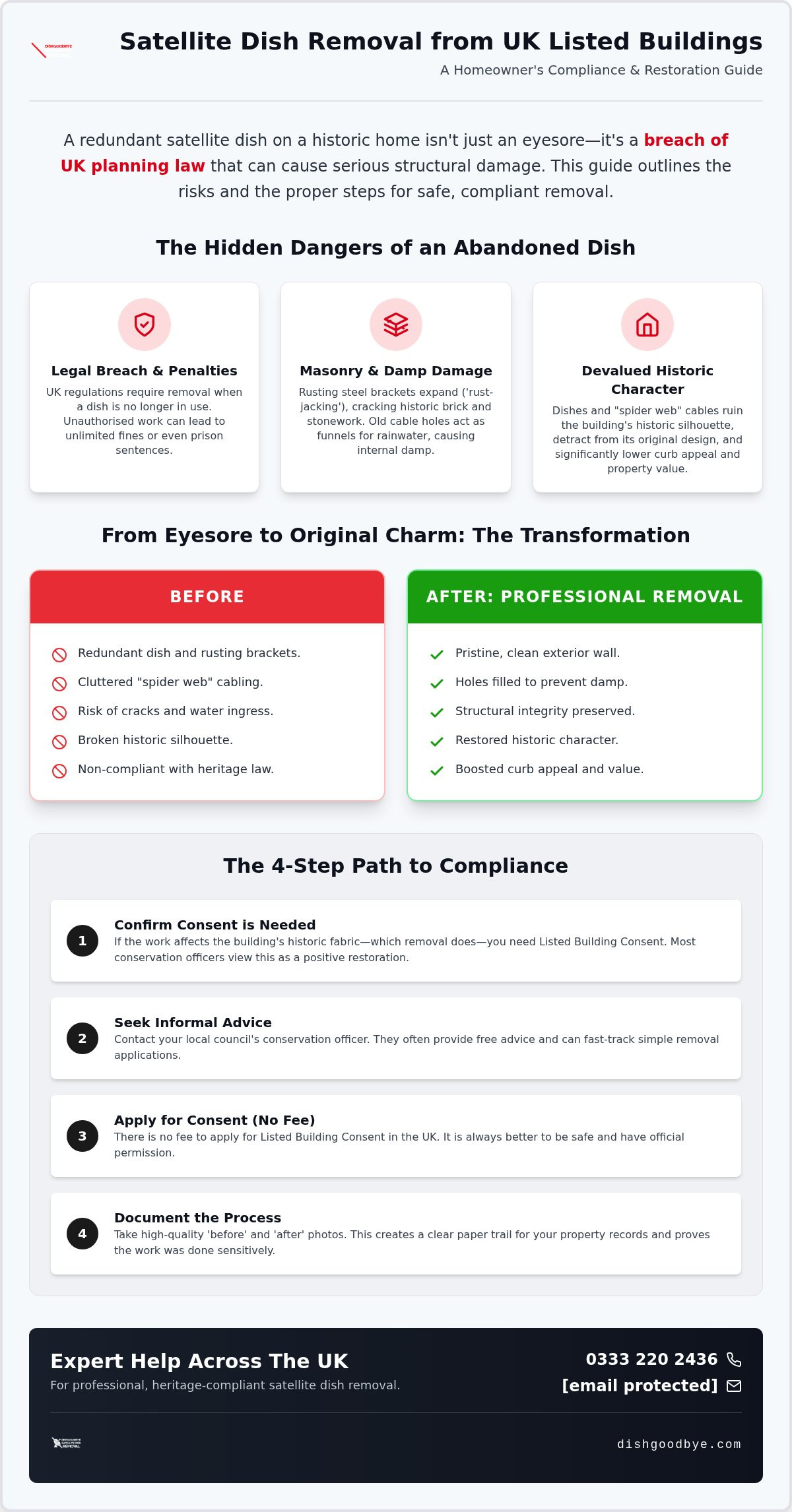
Old tech isn't just ugly; it's physically dangerous for historic walls. Most listed buildings use softer, pre-1919 bricks or lime-based mortar that can't handle modern steel fixings. Over time, these brackets rust and expand. Rust-jacking is the expansion of metal fixings that causes masonry fracture. As the metal grows, it puts immense pressure on the surrounding stone, leading to deep, expensive cracks. Abandoned cable entry points are just as bad. They act as funnels for rainwater, leading to localized damp and timber rot inside your walls. Taking the dish down stops this damage before it starts.
For expert help across the UK, contact us at 0333 220 2436 or [email protected].
For expert help across the UK, contact us at 0333 220 2436 or [email protected].
Understanding the Legal Requirements: Do You Need Consent for Removal?
The general rule for any listed property is simple. If the work affects the building’s character, you need consent. This applies to removing a dish from a listed building because the extraction process can physically alter the historic fabric. While it sounds like a lot of paperwork, most conservation officers view the removal of modern tech as a positive step. It's a restoration of the building’s original charm. However, you must avoid 'unauthorised alterations' at all costs. Since 2026, penalties for illegal works remain severe, including unlimited fines and potential prison sentences of up to two years. Always check your local authority’s specific stance before you start.
Keep a clear paper trail for your peace of mind. Document the entire process with high-quality 'before and after' photos. These are vital for your property records, especially if you decide to sell in the future. They prove the work was done sensitively without harming the masonry or the building's silhouette. As of August 2026, there is no fee to apply for Listed Building Consent in the UK, so it's always better to be safe than sorry.
The Role of the Conservation Officer
Don't be afraid to talk to your local council. Most conservation officers are happy to give informal advice over the phone or via email. Because removing a dish is seen as a benefit to the heritage site, these requests are often fast-tracked compared to new installations. Using a professional dish removal service ensures the job meets the high standards these officers expect. It’s a great way to simplify your routine and get the result you want without the stress of a planning dispute.
Grade I vs. Grade II Requirements
The level of scrutiny usually depends on your building's grade. Grade I and II* properties represent the top tier of UK heritage and require meticulous care. Even for Grade II buildings, which make up about 92% of listings, a botched DIY job can be a legal nightmare. If you crack historic masonry or use the wrong filler, you're legally liable for the repair costs. Professional certification of the work is a huge asset for future sales. It gives buyers confidence that the heritage status is fully protected. If you're ready to clear your facade, book your removal today and let the experts handle the heritage details.
For expert help across the UK, contact us at 0333 220 2436 or [email protected].
For expert help across the UK, contact us at 0333 220 2436 or [email protected].
The Risks of Improper Removal on Historic Masonry
Historic buildings require a gentle touch that modern construction simply doesn't. If your home was built before 1919, your bricks are likely much softer and more porous than today’s high-fired equivalents. These fragile materials were designed to work with lime mortar, allowing the building to "breathe" and move. When removing a dish from a listed building, a heavy-handed approach can cause permanent damage. Using power tools on friable stone or flint walls is particularly dangerous. The high-frequency vibrations can shatter the internal bond of the masonry, leading to loose stones and crumbling facades that are incredibly expensive to repair.
Avoid the temptation to use standard DIY fillers like Polyfilla. These modern products are usually gypsum or cement-based, making them far too hard for historic walls. They trap moisture behind the repair, which eventually forces the face of the brick or stone to pop off. This process, known as spalling, is a common result of trying to fix a heritage property with the wrong materials. When you're dealing with heavy, rusted brackets anchored into aged mortar, the risk of pulling out chunks of the wall is high. You need a methodical extraction that respects the age of the building.
The Problem with Modern Fixings in Old Walls
Modern expansion bolts are a nightmare for period properties. These fixings work by putting immense outward pressure on the hole to stay in place. In a soft historic wall, this constant stress can lead to hairline fractures that grow every winter. There’s also the issue of chemical reactions. When modern steel brackets meet traditional lime-based materials in the damp UK climate, the resulting corrosion can stain your beautiful stonework. Learn more about how damp from old fixtures can spread if holes aren't filled with the correct breathable mortar. It’s a small detail that saves your interior from costly water damage.
Why Ladder Safety is Different for Heritage Homes
Your building's decorative features are its best assets, but they’re also the most vulnerable. Leaning a heavy ladder directly against delicate parapets or ornate cornices can cause them to snap or crumble instantly. Professional teams use specialized stand-offs and protective equipment to ensure no weight is placed on these fragile facades. It isn't just about personal safety; it's about building safety. Professional height-access equipment allows for a stable, controlled environment. This ensures the technician can focus on the delicate task of extracting fixings rather than worrying about a wobbly ladder damaging your home's historic silhouette.
For expert help across the UK, contact us at 0333 220 2436 or [email protected].
For expert help across the UK, contact us at 0333 220 2436 or [email protected].
Step-by-Step: Best Practices for Restoring Your Listed Building's Exterior
Restoring your home’s exterior is a precise task. It requires a methodical approach that prioritizes the building’s health. Start with the cabling. Don't just pull on the wires. Carefully snip the plastic clips and extract the cabling to avoid snagging on old stone or delicate brickwork. Next, address the bracketry. Removing a dish from a listed building should never involve prying tools. Prying creates leverage that can snap fragile masonry instantly. Instead, unscrew fixings slowly. If a bolt is seized, use a penetrant rather than force to avoid unnecessary vibration.
Once the hardware is down, clean the area. Rust stains often leave orange streaks on light-coloured stone. Use a soft-bristle brush and water to lift these deposits gently. Finally, fill the voids. Leaving a hole open is an invitation for damp and pest ingress. Use a material-matched mortar that blends into the existing wall. This ensures the repair is structurally sound and visually seamless. It's a satisfying transformation that brings immediate relief to any homeowner tired of seeing ugly tech on their period facade.
Matching Historic Mortar
Using the right materials is non-negotiable for heritage properties. Standard cement is too rigid and waterproof for old buildings. You must use lime-based mortars instead. These traditional mixes are softer than the surrounding stone, ensuring the wall can move without cracking. Colour matching is also vital. A bright white patch on a weathered flint wall looks terrible. We match the aggregate and pigment to ensure the repair is invisible to the naked eye. Lime mortar is essential for the breathability of historic walls because it allows moisture to escape rather than trapping it inside the masonry.
Restoring the Clean Aesthetic
A successful removal leaves no trace of the 20th century. This includes managing cable entry holes that pass through the entire wall thickness. These must be filled from both sides to prevent cold bridges and internal damp. The goal is a completely clear, tech-free facade that looks exactly as the original architect intended. Once we've cleared the clutter, we handle the waste responsibly. Check our guide on satellite dish recycling to see how we keep old tech out of landfills. If you want a pristine finish without the DIY risk, schedule your professional removal with our nationwide team. We make it easy to say goodbye to the mess and hello to a cleaner home.
For expert help across the UK, contact us at 0333 220 2436 or [email protected].
For expert help across the UK, contact us at 0333 220 2436 or [email protected].
Professional Satellite Dish Removal for UK Heritage Properties
Dish Goodbye is the leading nationwide specialist for homeowners who value their property's history. We've built our reputation on a simple promise: we make removing a dish from a listed building a stress-free, satisfying experience. From the Highlands to the South Coast, our teams operate across the entire UK, bringing expert tools and heritage-sensitive techniques to every job. We understand that you aren't just looking for a technician; you're looking for a partner to help protect your home’s structural integrity. Our commitment to expert hole-filling ensures that once the hardware is gone, your masonry is sealed against the elements and future damp issues.
We take our environmental duties as seriously as our restoration work. Every bracket, dish, and cable we extract is subject to our 100% recycling policy. We ensure that old, rusted tech is disposed of through responsible channels, keeping electronic waste out of UK landfills. For landlords and homeowners, this service simplifies everything. You don't have to worry about finding the right mortar or figuring out how to recycle a bulky metal dish. We handle the heavy lifting, the technical extraction, and the clean-up, leaving you with nothing but a pristine, heritage-compliant exterior.
A Clean Slate for Your Historic Home
There is a unique sense of relief that comes from seeing your home’s facade returned to its original state. By removing years of tech-clutter, you allow the authentic character of the building to shine through. This isn't just about aesthetics; it's about peace of mind. We provide the professional results that conservation officers love to see, helping you stay compliant without the legal headache. A clear, well-maintained exterior is the fastest way to improve curb appeal across the UK. It transforms a cluttered house into a distinguished heritage home.
Book Your Specialist Removal Today
Ready to reclaim your home's historic silhouette? Our nationwide team is standing by to help. Removing a dish from a listed building has never been easier or more reliable. You can contact us directly at 0333 220 2436 to discuss your requirements. For a bespoke assessment, simply email photos of your property to [email protected]. We’ll review the fixings and the masonry type to ensure a perfect restoration. If you're tired of old tech ruining your view, it’s time to get a quote from Dish Goodbye. Let’s restore your home’s beauty together.
For expert help across the UK, contact us at 0333 220 2436 or [email protected].
For expert help across the UK, contact us at 0333 220 2436 or [email protected].
Protect Your Building’s Legacy Today
Restoring a historic property is about more than just aesthetics. It’s about fulfilling your role as a guardian of UK heritage. You now understand that removing a dish from a listed building requires a delicate balance of legal compliance and specialist masonry care. By choosing a professional approach, you avoid the heavy fines and structural damage that come with improper DIY methods. You protect your walls from damp and ensure every piece of old tech is recycled responsibly through our environmentally friendly processes.
Our nationwide team brings years of expertise to every project. We focus on complete bracket extraction and specialist hole-filling to leave your facade looking exactly as it was intended. Don’t let rusting steel and messy cables ruin your home’s character for another season. It’s time to embrace a cleaner, more authentic exterior that honors the past while protecting the future. Restore your listed building's beauty—contact Dish Goodbye for professional removal. We make the transition to a dish-free home seamless, safe, and satisfying.
For expert help across the UK, contact us at 0333 220 2436 or [email protected].
For expert help across the UK, contact us at 0333 220 2436 or [email protected].
Frequently Asked Questions
Do I really need Listed Building Consent just to remove a satellite dish?
Yes, you usually do. Any work that could potentially alter or damage the fabric of a protected property requires formal consent from your local planning authority. While the act of removing a dish from a listed building is viewed as a positive restoration, the method used must be approved to ensure the historic masonry remains protected. As of 2026, there is no fee for this application in the UK.
Will removing an old Sky dish leave permanent marks on my historic stone walls?
Professional removal ensures your walls remain pristine. While old steel brackets often leave orange rust stains, these can be lifted using gentle, heritage-safe cleaning techniques. Once the hardware is gone and the holes are filled with matched lime mortar, the previous location of the dish becomes invisible. This process restores the clean, authentic look your building was always meant to have.
What happens if I remove a dish from a listed building without permission?
Carrying out unauthorized works is a criminal offense in the UK. Penalties are severe and can include unlimited fines or a prison sentence of up to two years. Even if you think you're helping the building, the law requires a paper trail. Local authorities are increasingly proactive about regularizing these breaches, especially when a property is being prepared for sale.
Can I use standard DIY filler to plug the holes left by the dish brackets?
Never use standard modern fillers on historic walls. Products like Polyfilla or cement-based mortars are too hard and trap moisture, which leads to spalling and masonry decay. You must use a lime-based mortar that matches the original material's breathability and colour. This specialized approach keeps your home dry and ensures the repair moves naturally with the rest of the building.
How much does it cost to professionally remove a dish from a listed property in the UK?
Pricing for professional removal depends on several factors, including the grade of your listing and the height of the installation. Some jobs require specialized access equipment to reach high chimneys or delicate rooflines safely. For an accurate quote, contact our team with details about your property. We provide clear, upfront pricing for heritage-sensitive removals across the entire UK.
Are there specific rules for removing satellite dishes in Conservation Areas?
Yes, Conservation Areas have stricter "Permitted Development" rights. The 2015 General Permitted Development Order requires that satellite dishes be removed as soon as they are no longer needed. While you might not always need the same level of consent as a listed building, the priority is always to minimize the visual impact of modern tech on the historic environment.
What should I do with the old cables that run across the front of my listed house?
You should have them removed entirely. Redundant cables act as channels for rainwater, often leading to damp patches inside your home. We snip the plastic clips and extract the wiring carefully to avoid snagging on old stone. Removing these "spider webs" is a quick way to reclaim your home's silhouette and protect the facade from future water ingress.
Can Dish Goodbye help if the dish is located on a high chimney of a listed building?
Our nationwide service specializes in difficult-access removals. We have the equipment and expertise to handle dishes located on high chimneys, parapets, or awkward roof valleys without risking damage to your home's fragile features. We use stand-offs and protective gear to ensure our ladders never put pressure on delicate historic cornices or stonework.
For expert help across the UK, contact us at 0333 220 2436 or [email protected].