

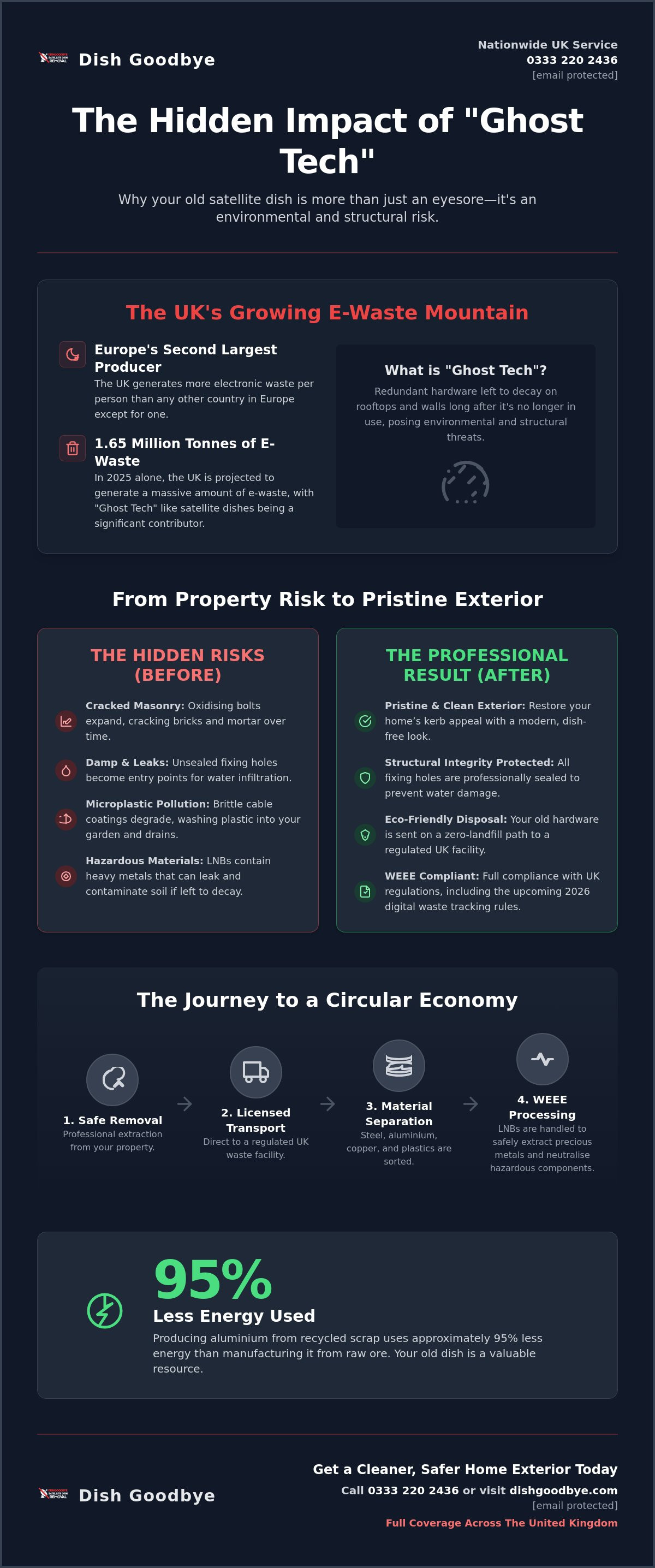
Did you know the UK is the second-largest producer of electronic waste per person in Europe? In 2025, our nation generated a staggering 1.65 million tonnes of e-waste. While we often focus on recycling smaller gadgets, the environmental impact of old satellite dishes left to rust on our chimneys is a growing concern. These metal relics don't just ruin your home's kerb appeal; they represent a significant amount of hardware that requires careful management under the 2026 digital waste tracking regulations to prevent soil and water contamination.
You've likely stared at those flapping cables or rusted brackets and felt a sense of dread about the height or the potential for damp. We agree that maintaining your home should be a source of relief, not a risky chore that lingers on your to-do list. This guide promises to show you how to responsibly remove redundant hardware to protect both your masonry and the UK environment. You will learn the most efficient ways to handle electronic waste, how to seal fixing holes to prevent future issues, and why a dish-free exterior is the ultimate lifestyle upgrade for the streaming era.
Key Takeaways
- Identify "ghost tech" on your property and understand the environmental impact of old satellite dishes left to rust in the British weather.
- Ensure your redundant hardware follows a zero-landfill path to a regulated UK waste processing facility rather than ending up in a local tip.
- Protect your home's structural integrity by learning how to seal fixing holes and prevent oxidising bolts from cracking your masonry.
- Stay safe and legally compliant by choosing professional extraction over risky DIY ladder work and improper domestic bin disposal.
- Transform your home's exterior into a clean, modern space that reflects the efficiency of the streaming age.
The Environmental Impact of Redundant Satellite Dishes in the UK
Millions of UK homes are currently playing host to what experts call "Ghost Tech". This term describes the redundant hardware left to decay on rooftops, chimneys, and walls long after a subscription has ended. As the streaming revolution replaces traditional broadcasts, these metal eyesores have become a silent burden on our properties. Understanding the environmental impact of old satellite dishes is the first step toward reclaiming your home's aesthetic and protecting the local ecosystem. It is a simple shift that transforms a neglected chore into a moment of domestic harmony.
Leaving a dish to rot isn't a neutral act. Over time, the protective plastic coating on coaxial cables becomes brittle under the British sun and rain. This degradation sheds microplastics directly into your garden and local gutters. Meanwhile, the internal components of the dish can leak substances into the ground. Beyond the local environmental impact of satellites and their terrestrial hardware, these abandoned items represent wasted resources. They belong in a modern circular economy, not hanging precariously over your patio. Removing them is a fast, effective way to clean up your property's environmental footprint.
WEEE Regulations and the Modern Homeowner
Under the UK’s Waste Electrical and Electronic Equipment (WEEE) rules, satellite LNBs (the electronic arm on the dish) are classified as hazardous e-waste. They contain complex circuitry and heavy metals that require specialist processing. By October 1, 2026, new digital waste tracking regulations will tighten the rules around how businesses handle this equipment. As a homeowner, you have a growing responsibility to ensure your "Ghost Tech" doesn't end up in a general landfill. Choosing a professional service ensures your old hardware is tracked and recycled according to the latest UK standards, giving you total peace of mind.
The Carbon Cost of Metal Degradation
Rusted brackets do more than just leave orange streaks on your brickwork. They leach iron oxide into the local soil and water, which can disrupt the natural balance of your property’s immediate environment. It is far better to recover these materials while they are still viable. Recovering high-quality aluminium and steel from redundant dishes is a vital part of sustainable property maintenance. Producing aluminium from recycled scrap uses approximately 95% less energy than manufacturing it from raw bauxite ore. You can learn more about zero-landfill extraction at Dish Goodbye, where we turn your old hardware into a win for the planet. Reclaiming your wall space has never felt so responsible or so easy.
Behind the Scenes: How We Recycle Your Old Dish and Cables
Once we've unbolted that rusted bracket from your chimney, the hardware begins a purposeful journey. It doesn't just sit in a van; it travels directly to a licensed UK waste processing facility. This logistical chain is essential because the environmental impact of old satellite dishes is most damaging when they are handled incorrectly or dumped in general skips. We don't believe in "out of sight, out of mind." Instead, we track every piece of hardware to ensure it meets strict UK environmental standards. It’s a seamless process that turns your household eyesore into a resource for the future.
The LNB, or Low Noise Blocker, is the most complex part of the assembly. It contains delicate circuit boards and electronic components that require expert handling. These are processed under WEEE guidelines to neutralise any hazardous materials. By extracting the tiny amounts of gold, silver, and palladium found in these electronics, we reduce the need for destructive mining. It's a small but significant way to protect the planet while clearing your wall space. If you're ready to clear the clutter, you can book your professional dish removal today and enjoy a cleaner home exterior.
From Aluminium to Copper: Material Extraction
Separating the different metals is a mechanical task that requires precision. Most satellite dishes consist of a steel reflector plate and an aluminium mounting arm. These metals must be separated because they have different melting points and recycling paths. Steel is incredibly durable and can be recycled into anything from car parts to construction beams. Aluminium is even more valuable; recycling it saves a massive amount of energy compared to creating new metal from scratch. We make sure every gram is accounted for during the extraction process.
The miles of redundant coaxial cabling running down your walls are another priority. These cables contain high-grade copper, which is in high demand for green energy technologies. We use industrial stripping machines to remove the outer plastic insulation. This allows us to recover the pure copper core while ensuring the plastic sheath is processed separately. This meticulous approach prevents plastic from leaching chemicals into the soil, keeping your local environment clean and safe. It's a satisfying result that benefits both your property and the wider UK ecosystem.
The Zero-Landfill Commitment
Our promise is simple: nothing we remove from your home ends up in a hole in the ground. For non-metallic components that are difficult to recycle, such as certain hardened plastics or rubber seals, we partner with certified UK waste processors. These experts use advanced techniques like energy-from-waste to ensure even the smallest parts have a final utility. This transparent tracking system is a core part of our service. You can learn more about the specifics in our Satellite Dish Recycling: The Complete UK Guide. It is about more than just cleaning a wall; it's about a definitive break from old-fashioned, wasteful habits.
Property Preservation: Why Eco-Friendly Removal Includes Masonry Care
A common worry for homeowners is that removing a dish will leave behind ugly, gaping holes. You might think it's safer to leave the hardware alone, but the opposite is true. While we've discussed the environmental impact of old satellite dishes in terms of waste, their physical presence on your wall is a ticking clock for your masonry. Over time, the heavy metal brackets and bolts undergo a process called oxide expansion. As the metal rusts, it physically grows in size, exerting immense pressure on the surrounding brick or stone. This can lead to visible cracks that compromise your home's structural integrity.
Abandoned fixings also act as a direct conduit for moisture. Rainwater hits the redundant metal and is funnelled straight into the fixing holes. This bypasses your bricks' natural protective layer and enters the cavity wall. This hidden moisture is often the root cause of internal damp patches that are expensive to fix. Reclaiming your wall isn't just about aesthetics; it's a vital act of property preservation that keeps your home dry and secure. It’s a simple upgrade that delivers immediate peace of mind and a much cleaner look.
Preventing Damp and Rust Staining
Iron oxide doesn't just damage the structure; it ruins the finish. When it rains, rust-saturated water trickles down your exterior, leaving permanent, stubborn orange streaks on your render or masonry. These stains are notoriously difficult to remove without professional chemicals. Even worse is the "freeze-thaw" effect. Water trapped in old, unfilled fixing holes expands as it turns to ice during a British winter. This expansion causes "spalling," where the face of the brick literally pops off. You can learn more about how unfilled holes can cause damp and structural decay in our dedicated guide. Preventing this damage is far cheaper than repairing a ruined facade later.
Restoring Curb Appeal and Property Value
If you're planning to sell, remember that first impressions happen at the kerbside. Savvy property surveyors and buyers now look for "dead" technology as a sign of poor maintenance. A house cluttered with rusted dishes and flapping cables feels dated and neglected. Our professional extraction process goes beyond just pulling the metal off. We use specialist exterior fillers, carefully colour-matched to your existing masonry, to smooth over the history of the installation. The result is a clean, minimalist exterior that highlights your home's architectural lines rather than its old subscriptions. It’s a satisfying transformation that makes your property stand out for all the right reasons.
Professional vs. DIY: Safety and Environmental Compliance
It's tempting to think that a bit of weekend DIY can solve your "ghost tech" problem. However, the reality of unbolting a rusted metal plate ten metres above the ground is often more stressful than expected. Beyond the physical danger, the environmental impact of old satellite dishes is significantly worsened when they are disposed of incorrectly. Tossing a dish into your domestic black bin isn't just ineffective; it's often illegal under UK waste regulations. These items are composite products that require industrial separation to be recycled properly. Choosing a professional path ensures you stay on the right side of the law while keeping your feet firmly on the ground.
There is also the hidden risk of "cowboy" collectors. You might see ads for cheap waste removal, but if that collector fly-tips your electronic waste in a country lane, you could be held legally responsible. Under the UK's "Duty of Care" laws, homeowners must ensure their waste is handled by a licensed carrier. A professional service provides you with an official waste transfer note, which acts as your legal shield. Stop worrying about the climb and book your professional Sky dish removal to ensure a safe, legal, and stress-free result.
The Risks of Working at Heights
Accessing a chimney-mounted dish requires more than just a standard household ladder. Professionals use specialised roof ladders and safety harnesses to navigate the unique angles of UK rooflines. Trying to maintain a three-point contact on a ladder while wrestling with a heavy, wind-catching dish is a recipe for disaster. Sharp, rusted edges can cause serious injury, especially when you're focused on your balance. We follow strict Health and Safety standards for residential work, ensuring the job is done without risking your property or anyone's well-being. It's a brisk, efficient process when handled by those with the right gear.
Guaranteed Responsible Disposal
When you handle removal yourself, the journey usually ends at the local tip, where items often sit in mixed skips. This doesn't guarantee the recovery of valuable materials we've discussed previously. Professional removal is the only way to ensure that 100% of the hardware, from the LNB to the mounting bolts, enters a certified recycling stream. This meticulous approach helps you avoid potential local authority fines for improper e-waste disposal. You get the satisfaction of a clean home and the relief of knowing you've done your bit for the UK's circular economy. It’s a modern solution for a modern household.
Reclaiming Your Home Exterior with Dish Goodbye
It's time to say a definitive goodbye to the "ghost tech" haunting your chimney. At Dish Goodbye, we believe that reclaiming your home's exterior should be a satisfying and low-effort experience. Our service isn't just about unbolting a metal plate; it’s a total restoration of your property’s aesthetic. We handle the complete extraction process, including the removal of rusted brackets, unsightly wires, and every single fixing that has been left to decay. By choosing a professional team, you directly mitigate the environmental impact of old satellite dishes while instantly boosting your home's kerb appeal.
Our insured technicians arrive ready to transform your roofline from a cluttered relic of the past into a clean, modern surface. We don't just pull the hardware off and leave; we treat your masonry with the care it deserves. Every project includes our signature hole-filling service as standard, ensuring your home remains watertight and beautiful. Whether you're a homeowner looking for a lifestyle upgrade or a landlord managing multiple sites, we provide a seamless solution that fits into your busy schedule. You can book your eco-friendly removal today by calling our team or sending us a quick email. It’s a simple shift that delivers a massive sense of relief.
Nationwide Service Across the UK
We pride ourselves on offering a truly national service that reaches every corner of the United Kingdom. From the tip of Penzance to the highlands of Perth, our technicians provide the same high standards of environmental care and property restoration. You don't have to worry about local variations in service quality or pricing. We maintain consistent standards across the country, ensuring every dish we remove enters a certified zero-landfill recycling stream. For commercial property managers and landlords, we coordinate multi-site removals with the same efficiency, providing a tidy and professional result for every building in your portfolio. Distance is never a barrier to a cleaner, safer home.
What to Expect from the Removal Process
Transparency is at the heart of what we do. When our technician arrives, they start with a safety assessment to determine the best access point for your specific roofline. The extraction itself is brisk and energetic, usually taking under an hour for a standard residential project. Once the hardware is safely down, we focus on the masonry, using high-quality fillers to seal the fixing holes. Finally, we load the old tech into our van for transport to a regulated UK waste facility. You can read more about how our professional dish removal service protects your property in our detailed guide. It’s a swift transition from disorder to cleanliness that you’ll notice every time you pull into your driveway.
Reclaim Your Home’s Modern Aesthetic Today
You’ve seen how easy it is to transform your property while doing your bit for the planet. Removing redundant hardware isn't just a cosmetic fix; it's a vital step in reducing the environmental impact of old satellite dishes on your local ecosystem. By choosing professional extraction, you stop rust expansion in its tracks and ensure hazardous electronic components never reach a landfill. It is the ultimate lifestyle upgrade for any modern UK household.
Stop letting "ghost tech" linger on your chimney. Our nationwide UK service at 0333 220 2436 provides a zero-landfill recycling guarantee and includes full masonry restoration as standard. We take care of the heights, the sharp metal, and the hole-filling so you don't have to. Say goodbye to your old dish and book your UK-wide removal today. Enjoy the relief of a clean, efficient, and beautifully maintained home exterior.
Frequently Asked Questions
Is it legal to put an old satellite dish in my household bin in the UK?
No, it's not legal to dispose of a satellite dish in your standard household bin. These items are classified as Waste Electrical and Electronic Equipment (WEEE) and must be handled through regulated channels to avoid local authority fines. Proper disposal prevents hazardous components from entering the general waste stream and damaging the environment. It is a simple step that keeps your household compliant and your conscience clear.
Can satellite dishes be recycled at local UK council tips?
Yes, you can take a dish to most UK council household waste and recycling centres (HWRCs) for free. Since satellite dishes fall under producer compliance schemes, councils generally don't charge householders for disposal. However, you'll still need to safely remove the dish from your roof yourself before transporting it. Choosing a professional service saves you the risky ladder work and the trip to the tip.
How much of a satellite dish is actually recyclable?
Almost 100% of a satellite dish assembly is recyclable when processed by specialists. The steel reflector, aluminium arms, and copper wiring are all high-value materials that can be returned to the circular economy. This recovery significantly reduces the environmental impact of old satellite dishes compared to leaving them to degrade. It's a satisfying result that turns yesterday's tech into tomorrow's resources without any extra effort from you.
Will removing the dish leave visible damage or holes on my exterior wall?
Removing a dish won't leave your wall looking like Swiss cheese if you choose a professional service. We include a specialist hole-filling and masonry restoration step as standard with every removal project. We use colour-matched exterior fillers to smooth over the surface, leaving your home looking clean and hardware-free. You get a smooth, tactile result that makes the old installation a distant memory.
What happens if I just leave my old Sky dish on the wall for years?
Leaving a redundant dish on your wall leads to rust staining, masonry cracks, and potential damp issues. As the brackets oxidise, they expand and put pressure on your bricks, while the cables act as a conduit for rainwater. It’s a slow process of decay that eventually becomes an expensive repair job. Clearing the clutter now prevents these structural headaches and keeps your home exterior in peak condition.
Do you remove the cables and brackets as well as the dish itself?
Yes, we perform a complete extraction of the entire system. This includes the dish, the LNB, the mounting brackets, and all associated external cabling. We don't believe in half-measures; we clear everything to ensure your property's exterior is completely reclaimed and refreshed. It is a total clean-up that leaves your walls looking minimalist and modern, exactly as they should be in the streaming era.
How long does a professional eco-friendly dish removal take?
A standard residential removal project usually takes less than an hour from start to finish. Our technicians work briskly and efficiently to ensure minimal disruption to your day. You can transition from a cluttered roofline to a clean, modern exterior in the time it takes to have a lunch break. It’s a fast-paced, high-energy service designed to respect your time and energy.
Is your dish removal service available across the whole of the UK?
Our service is available nationwide across the whole of the UK. Whether you’re in a city centre or a rural village, our insured technicians provide consistent pricing and environmental standards. We bring professional property maintenance to every doorstep from Penzance to Perth. You can enjoy the same reliable, solution-oriented help regardless of where you live in the United Kingdom.